Landed Cost, Explained: What an International Order Really Costs
Landed cost is the full price of getting one unit to a customer's door in another country: product, freight, duty, taxes and every fee in between. Sellers who don't know it per SKU are pricing blind, and usually find out on a carrier invoice weeks after the sale.
What goes into landed cost
- Product cost, what you paid for the unit.
- Freight and insurance, the international leg, plus fuel and remote-area surcharges.
- Import duty, a percentage set by the destination tariff line for your HS code. Anywhere from zero to 20%+ depending on product and origin.
- Destination taxes, VAT in the EU and UK, GST/HST/PST in Canada, charged on the import.
- Brokerage and disbursement fees, what the carrier or broker charges to clear the goods and advance the duty money.
Where sellers get surprised
The duty basis differs by country. The US charges duty on the goods value alone (FOB). Canada and the EU charge on goods plus freight and insurance (CIF). The same $40 item with $20 shipping carries duty on $40 into the US and on $60 into the EU.
De minimis thresholds cut both ways. Orders under the threshold clear duty-free: $800 into the US, €150 for duty into the EU. Sellers assume that story travels; it doesn't. The EU charges VAT from the first euro, Canada from CAD $40 by courier. A "duty-free" order still lands with 20% VAT and a brokerage fee attached.
The fee stack is invisible until it isn't. Duty of $0.00 can still come with a $15 disbursement fee under DDU, which is why the incoterm choice matters; see DDP vs DDU.
Calculating it per SKU
- Classify the product: the destination-country HS code sets the duty rate.
- Apply the duty basis: FOB or CIF depending on the country.
- Add destination taxes on the taxable base (which usually includes the duty itself).
- Add brokerage, disbursement and carrier surcharges.
Do this once per SKU per market and your pricing, margins and DDP decisions all stop being guesses.
Knowing it before you buy the label
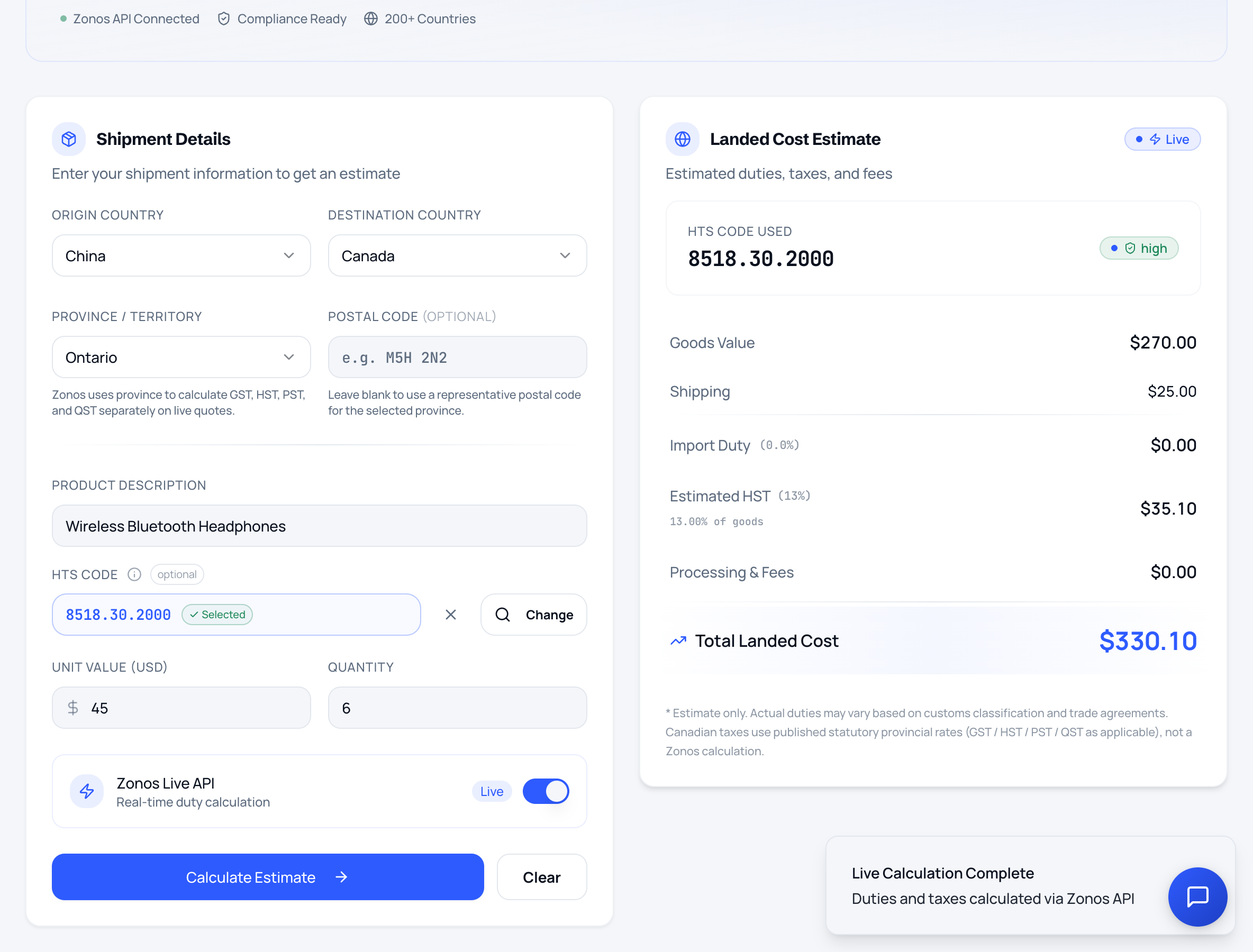
Treqo runs this calculation live at booking: per item, per HS code, per destination, including provincial Canadian taxes and the fee stack, so the landed cost is on screen before the label exists. It also feeds DDP labels, so what you pay is what was quoted.
Curious what your current lanes really cost? Run a free rate benchmark, or see Treqo’s customs and landed-cost tools.
Frequently asked questions
What is included in landed cost?
Product cost, international freight, insurance, import duty, destination taxes such as VAT, GST or HST, customs brokerage and disbursement fees, and carrier surcharges.
What is a de minimis threshold?
The value below which a country charges no duty (and sometimes no tax) on imports. US: $800. Canada: tax above CAD $40, duty above CAD $150 on courier shipments from the US or Mexico. EU: VAT on everything, duty above €150.
Is duty calculated on the product price or the shipping too?
Depends on the country. The US uses FOB basis (goods only); Canada and the EU use CIF basis (goods plus freight and insurance).
Ship globally, without the complexity.