HS Codes Explained: How Wrong Classification Quietly Costs Sellers
HS code classification for ecommerce is the piece of customs paperwork most sellers never look at, and the one that quietly sets the price of every international shipment they make. Six digits, extended to ten in the US and Canada, sitting on a commercial invoice. Get them right and duty is what you expected. Get them wrong and you either overpay on every unit for years without noticing, or underpay until an audit catches up and asks for the difference. Nobody sends you a letter when your codes are wrong.
What an HS code actually is
The Harmonized System is a product catalogue maintained by the World Customs Organization and used by more than 200 countries. It sorts every physical good into a numbered hierarchy: chapter, heading, subheading. The first six digits are identical everywhere, so 6109.10 means cotton knitted T-shirts in Toronto, Rotterdam and Sydney alike.
Past six digits, every country adds its own tariff lines. The US extends to ten digits in the HTS; Canada also uses ten. Those extra digits are where the duty rate lives. A code that is valid in the United States is not a valid Canadian code, and the rate attached to it is often different. This is the single most common misunderstanding we see: sellers treat one code as a global answer.
Where HS code classification for ecommerce goes wrong
Five patterns account for almost every misclassification we find when we audit a new customer's catalogue.
- Copying the code off a supplier's invoice. Your factory classified the goods for export from their country, under their tariff, sometimes carelessly. That code is a starting point, not an answer.
- One code for the whole catalogue. A single code applied across every SKU is fast and almost always wrong somewhere. Material changes the code. A cotton shirt and a polyester shirt are different lines with different rates.
- Classifying by what the product does, not what it is. The Harmonized System mostly cares about material and construction, not marketing category. "Fitness accessory" is not a classification input; "knitted, of synthetic fibres" is.
- Keyword-searching your way to a code. Typing a product name into a tariff search box gives you plausible-looking results with no legal reasoning behind them. Classification follows the General Rules of Interpretation, in order, and those rules regularly land somewhere a keyword search would not.
- Stopping at six digits. Carriers will often accept a six-digit code and let the broker guess the rest. The guess is made by someone who has never seen your product.
What wrong codes actually cost
There are two failure directions, and they hurt differently.
Overpaying is invisible. Nobody at customs corrects you for paying too much. Cotton T-shirts entering the US under 6109.10.00 carry a 16.5% general rate. Move the same shipment to a line where a trade agreement applies and the rate can go to zero. If you are landing $250,000 a year of goods and sitting two points above the correct rate, that is $5,000 a year leaving quietly, with no line item anywhere that says why.
Underpaying is a bill you get later. Customs authorities work backwards. In the United States, CBP can generally reach back five years to recover unpaid duty, with interest, and penalties on top where they find negligence. Canada, the UK and the EU all run reassessment periods of the same order. Sellers discover this when the first notice arrives covering three years of shipments they had already accounted for as profit.
The third cost is time. Ambiguous or inconsistent codes are one of the most common triggers for a documentary hold, and a held parcel is a support ticket, a refund risk and a customer who will not order again.
Trade-agreement eligibility depends on the code too. USMCA and CUSMA preference is claimed against a specific tariff line; classify the goods incorrectly and you can lose duty-free treatment you were entitled to.
How to get classification right
- Start from material and construction. What is it made of, how was it made, what is its essential character. Write that down for each SKU before you touch a tariff tool.
- Use the official tariff, not a search engine. The USITC publishes the full HTS; CBSA publishes the Canadian Customs Tariff; the EU has TARIC. Read the chapter notes and section notes, which override intuition more often than people expect.
- Store codes at the SKU level. Classification is worth doing once. Keep it in your product data so it flows onto every shipment automatically rather than being re-decided by whoever is packing.
- Classify per destination. Reuse the first six digits; look up the national digits for each market you sell into.
- Get a binding ruling on the hard ones. For high-volume products, or where two plausible codes carry very different rates, request a ruling from the customs authority. In the US that is CBP's eRulings process. It is free, it takes weeks, and it ends the argument permanently.
How Treqo handles it
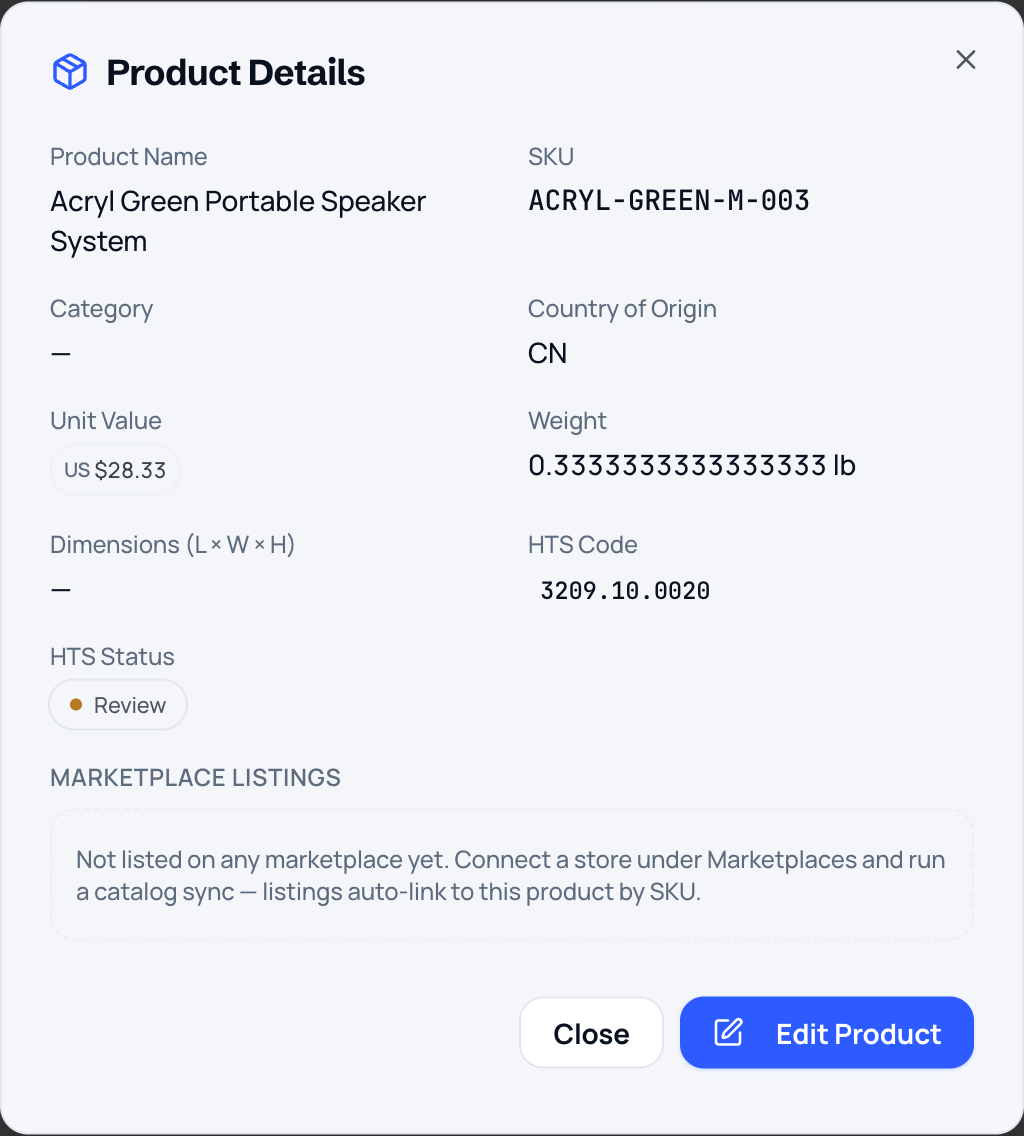
We built classification into the platform because we were already doing it by hand for our fulfillment customers. Treqo assigns per-country HTS codes across your product catalogue with a confidence score on each one, so you can see which SKUs are settled and which need a human look. Those codes then enrich the customs data on every booking automatically, and feed the landed-cost calculation, so duties and taxes are known before you buy the label rather than discovered afterwards.
When something is genuinely ambiguous, or a shipment gets held, you talk to our clearance team rather than a ticket queue. More on that on the customs and compliance page.
Frequently asked questions
How many digits does an HS code have?
The international code is six digits, and those six digits mean the same thing in every member country. Individual countries extend the code for their own tariff: the US and Canada both use ten. You need the full national-length code for the destination country, not just the first six.
Who is responsible if an HS code is wrong, me or my carrier?
The importer of record is responsible. Carriers and brokers transmit the code you give them; they do not warrant that it is correct. If you ship DDP or act as a non-resident importer, that liability is yours.
Can I use the same HS code for every country I ship to?
The first six digits, yes. Beyond that, no. Each country builds its own tariff lines on the six-digit base, and duty rates differ line by line.
What is a binding ruling and when do I need one?
A written classification decision from the customs authority that you can rely on. Worth the effort for a high-volume product, a genuinely ambiguous product, or any case where two plausible codes carry very different duty rates.
Ship globally, without the complexity.